Grounding
Lost in my work, my prompts, and my books, my head was up in the clouds... But the hospital's ER sent it crashing back down.
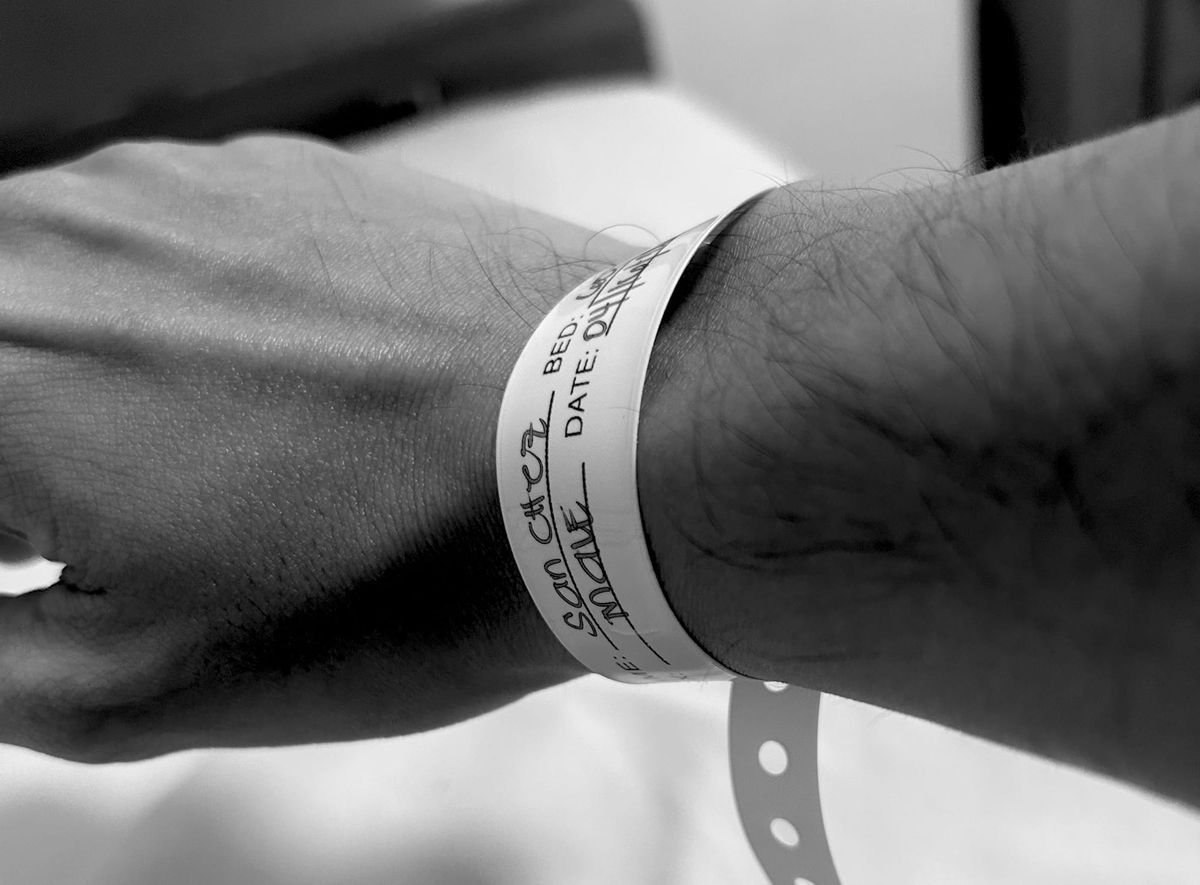
One night blood started draining out of me.
It was around 1:00AM, and as my wife and daughter slept, I hurriedly got out of bed feeling extremely bloated and with an urge to throw up.
In the bathroom, dizzy, I relieved myself.
Then I saw it: thick, pitch-black blood from my gut. Like tar. Or sewer drainage. In the bottom of the bowl.
I had been having problems with my gastrointestinal system for months, and just a few hours before had come back from the hospital from a diagnostic procedure. Doctor said they didn't see anything.
But there I was, just a few hours later, heart pounding, as I stared into the horrifying scene I had been dreading to see. This was the symptom all the articles online warned me about. They said if you saw this symptom, you're in really bad shape.
And then I drained more. A lot more inky, black blood.
I panicked. The bathroom walls started to spin. And I lost consciousness.
The days leading up to me undergoing three consecutive procedures in three consecutive days at the hospital, each time terrified when the anesthesia wore off that the doctor was going to tell me the darkest news, were like the orchestral crescendo in A Day in the Life—a buildup of panicked notes rising to an ear-shattering end.
Things had never been more uncertain at work, yet I was nevertheless doing even more work.
I would constantly read about colleagues suffering severe illnesses no doubt related to the unending anxieties and pressures of our industry. And what made it worse was that the algorithm knew me. It fed me just the right kind of content to keep my fear growing in the guise of being concerned about my health.
Every day, Anthropic would announce a new product on X. Every day, some company's stock plummeted. And every day, I daydreamed that I was a simple factory worker on an assembly line, my mind peacefully empty and ignorant of these details.
Throughout all this, I didn't sleep very well. Many nights I barely slept at all.
I told myself I should be ok. I do try to stay healthy. But against such a juggernaut of physical and spiritual deterioration, eating my greens and doing a bit of jogging never really stood a chance.
Many times I'd imagine my head floating away like a balloon.
I was trying desperately to catch it mid-flight and hook it onto something that made sense. Something more substantial than just another article predicting the latest job loss estimates by some billionaire.
In fact, I was reading Jean Baudrillard, the French philosopher who famously described the hyperreal—when the simulated feels more vivid than reality. I remembered him from my theory classes back in college. He came to mind so naturally given the subject.
But it soon became obvious that Baudrillard was writing from a different time (the '70s and '80s)—and the hyperreal he seemed to so despise almost felt nostalgic to me. Cozy. Homey.
This—whatever this we're grappling with right now, is several evolutionary or metastasis stages above what he wrote about.
And everything was spinning out of control.
When I came to, I didn't know where I was.
I didn't know who I was.
I didn't know what I had been doing.
There was a rectangular something on the floor with a picture of a beautiful baby on the back.
I was naked.
There was an uncanny feeling that I was seeing the world for the first time with fresh eyes—and everything looked strange and haunting.
What was this space? What were these objects?
But then the memories came flooding back.
I'm here because I am bleeding internally. I'm here because there's something seriously wrong with me.
I started to gasp for air. It's so hard to breathe. Suddenly, my skin grew cold, like ice cubes were melting into my bones. I'd never felt my heart race as fast as it did at that moment. I was hyper-aware that it might seize and quit on me anytime, and all I could do was try my hardest to clutch at my thighs and struggle to breathe even as the stone-cold chill crept to my head and threatened to take me out again.
I had never felt so weak. The slightest push could have floored me and curled me up.
For the first time ever—and there's really no putting it another way—I felt like I could die, and the fear was primal.
Amidst this terror was also an overwhelming sense of tragedy.
To know that life could be this abrupt. That it could be this short and inconclusive. There's just so much I had not been able to do yet.
The graphic novel I wanted to draw.
The books I have paused for so long.
In the other room, my wife and daughter dreamt soundly, and all I could think about was not even having kissed them goodbye.
Interestingly, I also felt shame—embarrassment for potentially dying in a manner so undignified: sitting in a toilet bowl, naked. Stool unflushed.
Like Tywin Lannister.
I think the thought of such humiliation gave me just enough energy to stabilize myself, drag my feet back to our room, and wake up my poor wife.
"I need to go to the ER," I told her in between the shortest and most difficult of breaths.
Lost in my work, my prompts, and my books, my head was up in the clouds.
It's thousands of feet above ground, looking down on my body and the patchwork of structures below, trying to decipher patterns from the noise and scattered data. Inferencing.
But the hospital's ER sent it crashing back down.
I had not even stepped foot inside the ER when a car came screeching to a halt in front, honking its horn. "CODE! CODE!" yelled one of the hospital staff.
I stood back as they rushed a man in a stretcher through the doorway, and a doctor and most of the nurses hurriedly flocked to the patient, immediately pumping his heart. His naked, lifeless body shook violently as their palms thrust into his ribs with furious force over and over again.
Just a few inches beside this man was another patient lying on a bed, seemingly unconscious, just partially hidden by thin purple curtains. Both of his eyes were shut with cotton and gauze as if somebody poked them out of their sockets, and they were trying to hide the holes from everyone.
The shock of seeing these grim scenes all at once yanked me so hard back to reality that I felt like I had been sleeping a long time and had just woken up.
I would spend several hours in the ER as I waited for a private room to become available. Sleep would not come, and throughout the day, I'd hear families weeping uncontrollably as loved ones left them, the echoes of their lament visiting every cubicle. I saw kids and babies bawling as they were injected with medicines they needed. I heard an elderly wife explain matter-of-factly to a nurse that her husband, who's on a wheelchair, had cancer. She said it like it was the most natural thing. Like he had the flu, and they must be going.
Amid all the uproar, I had never been more aware of my body. As more black blood drained out of me, and as I continued to feel faint, my attention couldn't escape the sheer physicality of my existence.
The medical staff took a complete blood count every eight hours, monitoring if my bleeding had stopped or worsened. I was so fixated upon my body, that it was as if I was trying to feel every single cell's movement and listen to every undulation in my gut. I was willing them to get better.
Quickly, I forgot about work. That whole world started drifting away from me, like a game I was no longer permitted to join. But the stark contrast between my frailty and pain (the stinging in my vein hooked to an IV for days, the extreme hunger I felt as I couldn't eat or drink) and the trivial things I used to obsess over for my job struck me.
"Agentic workflows" and "reasoning models" and "compute" and "AI overviews" and "citations" and "answer-ready content" and "hyperreality"—I loathed the thought of them. How pointless they were. Superfluous.
The only thing that was real was flesh and blood.
And the only thing I needed was to be able to get a second chance at spending the rest of my life with my wife and daughter again.
What I don't want is for this experience to just get relegated to the junk room of memories, as if it never happened; to get sucked back into the game without a larger understanding of what's at stake, and without a mission to do better from here on out.
I want to remember. I want to remember my desperation for some good news. And I want to remember my overwhelming gratitude when I did finally hear it from the doctor. But more importantly, I want it stamped in my mind how utterly silly the game looked from the vantage point of someone gazing up at the big, looming surgical lamps for the third time.
In AI terms, they call this grounding—a way to stop AI from hallucinating by tying its output to specific, verifiable information.
For a long time, I have felt abstracted and disembodied.
This was my grounding. My tethering to what's real.
The answers I was seeking were not to be found in any meta theory of reality or hyperreality.
They were to be found in the simple, humbling, but terrifying fact that I can go only as far as my body decides I go. And that what I need more than an escape from or explanation about my situation, is just more time spent with the ones I love.